

“Our rules of engagement are bold, precise and designed to unleash American power, not shackle it.” The last few months have been a very busy time for US Secretary of War Pete Hegseth. Too busy, perhaps, to leave room for him to write his own speeches. We hear a lot of “It’s not X – it’s Y”s, a lot of “rule of threes”, a lot of those not-so charming quirks that a few years ago would’ve struck us as formulaic marketing guru speak, but these days give off the rancid new-car-smell of ChatGPT. “Write a press briefing in the style of the Call of Duty: Modern Warfare trailer,” he seems to have asked, spitting out a string of non-stop mic-drop moments like “We’re playing for keeps.” Speaking to reporters on 2 March, he set out his justification for the war as follows:
“Crazy regimes like Iran hell-bent on prophetic Islamist delusions cannot have nuclear weapons. It’s common sense.”
The next day, an anonymous non-commissioned officer, on behalf of himself and 15 other unit members, would report to the Military Religious Freedom Foundation that, in a combat readiness briefing that morning, they had been told “President Trump has been anointed by Jesus to light the signal fire in Iran to cause Armageddon and mark his return to Earth.” The war, they were assured, “was all part of God’s divine plan”. That was a Tuesday. The Saturday before, 168 Iranians had been murdered in a US triple-tap strike on Shajareh Tayyebeh Elementary School. Most of them, girls under the age of 12.
When Bush framed the Iraq War in similarly, though by comparison much more modestly, religious terms, the liberal atheism of the 2000s was celebrating its heyday on both sides of the Atlantic, and produced no shortage of pundits ready to give him the full broadside. Richard Dawkins accused the president of “seeing the world as a battleground between St Michael’s angels against the forces of Lucifer”. In the arch, waspish, tone that defined the era, Dawkins satirised Bush: “We’re gonna smoke out the Amalekites, send a posse after the Midianites, smite them all and let God deal with their souls.” In the closing monologue of his Religulous documentary (two stars from The Guardian), Bill Maher was more uncompromising: “The plain fact is, religion must die for mankind to live. The hour is getting very late to be able to indulge in having key decisions made by those who would steer the ship of state by the equivalent of reading the entrails of a chicken.”

These were the days of the founding of The Church of the Flying Spaghetti Monster; of Trey Parker and Matt Stone giddily fishing for the ire of religious types in South Park, winning death threats and censorship demands for their depictions of Muhammed and the Virgin Mary; Ron Reagan, the former president’s son, appeared in a TV ad for the Freedom From Religion Foundation, telling audiences he’s “not afraid of burning in hell”.
If there is one particular cultural artefact in which the period finds in its most distilled expression, it is The Four Horsemen: a two hour panel discussion between New Atheist kingpins, Richard Dawkins, Christopher Hitchens, Sam Harris, and Daniel Dennett. It is, admittedly, not especially high-brow. Hitchens aside, the group are not quite so intellectually formidable as they evidently believe – in hindsight, like much of the atheist snark of the 2000s, without the context of the low bar for erudition set by President Bush, a lot of it comes off undeservedly self-serious. Nonetheless, the explicitly religious justifications given for the twin horrors of the age, the 9/11 attacks and the Iraq War, lent their ideas a kind of moral urgency that shall cover a multitude of sins. There is, hovering over that gang of four, a ghost at the feast. And the name of that ghost is Dr. Gregory House MD.
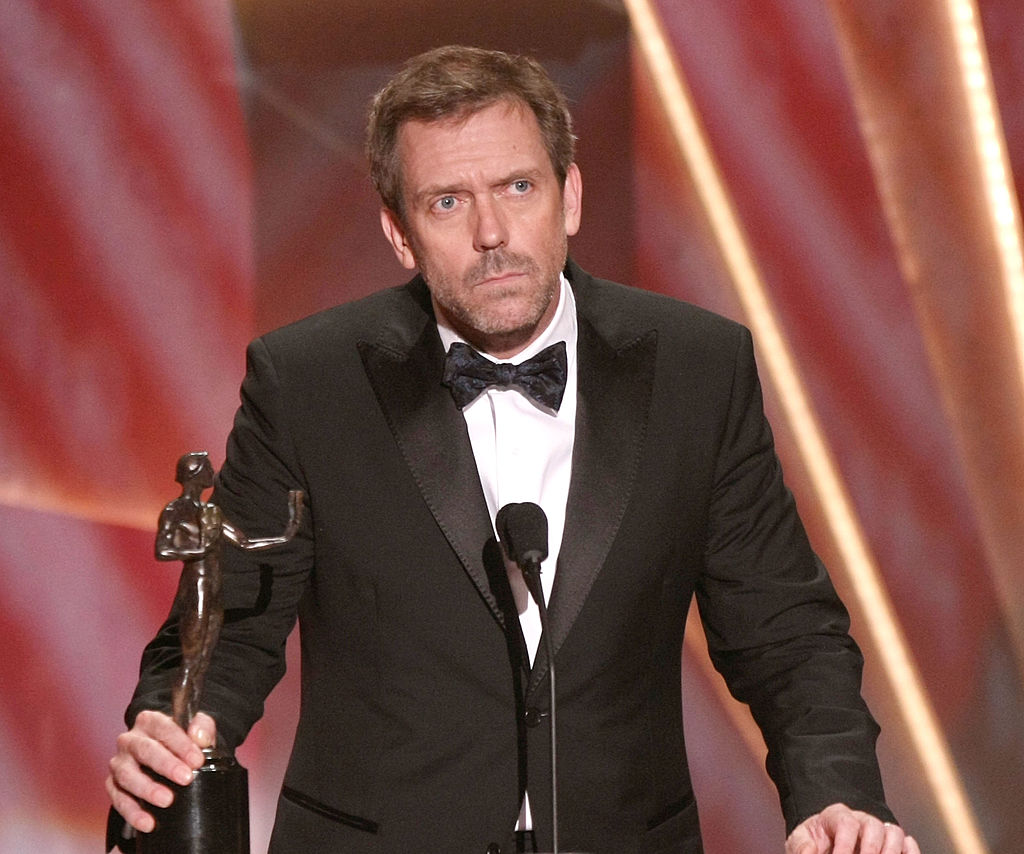
The pillpopping, whoremongering, diagnostician-savant was the fictional avatar of the Zeitgeist. His attacks on religion, shoehorned a little hamfistedly into the show, are delivered as blithely and as often as those of Dawkins or the hosts of Jon Stewart’s Daily Show. In House, all the virtues of the 2000s liberal atheist are lucidly articulated. Self-consciously witty, irreverent, and vulgar; occasionally racist and sexist, but only in the eminently forgivable, ultimately benign, way the writers of South Park allowed themselves to be racist and sexist. Every bit the inverse of the trope of the fat, unintellectual, sanctimonious Evangelical that formed the anti-Bush camp’s archetypal nemesis.
The mood typified by Hugh Laurie’s Dr House was born not only out of the backlash against the folksy pharisaism of the Bush administration – the cowboy hats, the infamous “crusade” remark regarding the War on Terror, the less-than-candid photos of his cabinet bowed in prayer, John Ashcroft’s bizarre decision to have himself anointed with vegetable oil, before being sworn in as Bush’s Attorney General – but equally a backlash against the less-well remembered, but no less ostentatious, Christianity of Al Gore and John Kerry, vying to claw back the white Evangelical vote for the Democrats. In 1999 Al Gore ran on a flagship policy of permitting federal money to be spent on religious organisations for drug treatment, homelessness and youth violence prevention; “What we’re seeing,” he told the Washington Post’s EJ Dionne Jr that year, referring to this common ground with Bush, “is the end of a 400-year period of allergy to faith.”
Pointedly choosing to announce his campaign from his boyhood home in rural Tennessee, Gore told the crowd, “with your help, I will take my own values of faith and family to the Presidency”. In a December 1999 debate, Bush answered the question, “Who is your favourite political philosopher?” with: “Christ.” Eager not to let him have the last word, Gore told voters he frequently asked himself on the campaign trail, “What Would Jesus Do?” Like Gore and Bush themselves, the Democratic Party – the same Democratic Party which in 1992 had vetoed any reference to “God” in its National Platform – looked to be “born again”. The hard separation of church and state of the 1970s and 1980s, which saw classroom displays of the Ten Commandments, school prayer, and Creationism on the syllabus all struck down by the Supreme Court, seemed to be thawing. The mood among liberals was given voice in the title of Jeffrey Rosen’s jeremiad in a January 2000 issue of New York Times Magazine: “Is nothing secular?” John Kerry, running for the Democrats in 2004, did not change course; in a candidacy acceptance speech that began with the words “I’m John Kerry and I’m reporting for duty,” he told us: “I don’t wear my faith on my sleeve.” Meanwhile, mentions of “God” in the National Platform jumped from one, at the last election, to seven.
What must’ve struck the secularists as so maddening is none of this bore any relation to anything happening outside of politics – the arms race in showy religiosity between Bush and his challengers was set against the backdrop of a sharp decline in belief among the public, rapidly picking up speed from 2000 on. The Evangelical Lutheran Church in America reported a drop in attendance of just under 0.6 per cent from 1994 to 2000, then of 15 per cent from 2000 to 2008. In 1999, Paul Weyrich, co-founder of Moral Majority, wrote a letter to religious conservatives, admitting the culture war was over and that Christians had been defeated:
“In terms of society in general, we have lost… we need to drop out of this culture, and find places… where we can live godly, righteous and sober lives. Again, I don’t have all the answers… but I know that what we have been doing for thirty years hasn’t worked, that while we have been fighting and winning in politics, our culture has decayed into something approaching barbarism.”
Both Weyrich and the readership of the New York Times would have agreed that the new-found faith on both sides of American political life was a sham: an entirely top-down, performative, phenomenon that had nothing to do with what was really happening in the culture at large. And what was happening in the culture at large? Hugh Laurie starred as Dr Gregory House MD. The reason the show deserves particular attention is that, running from 2004 to 2012, it serves as a record of trends in American liberal consciousness before and after the twilight of the Bush era; 2008 stands out like the subtle change in rock formation between two strata of a cliffside, from which a geologist deduces he is looking at the high water mark of some long-vanished prehistoric ocean.
Here is the perfectly typical plot of an episode from the Bush years. In “House vs.God”, (aired April 2006) the patient is a smarmy teenage Pentecostal faith healer, brought to hospital after an unexpected collapse. House begins his course of treatment with a string of surly New Atheist barbs like: “Faith – that’s just another word for ignorance, isn’t it.” His cynicism is briefly challenged when the healer supposedly cures the cancer of another patient by his miraculous touch – but in the end, it’s revealed that this is only because the boy has transmitted his herpes to her, which attacked the tumor, and House’s initial biases are neatly affirmed. The diagnosis of a sexually transmitted disease confirms the boy is not only a fraud but a hypocrite. Clean, simple, proper.
Compare with the plot of “Unfaithful” (aired February 2009). A Catholic priest checks himself into Princeton-Plainsboro after receiving a vision of Christ he writes off as a hallucination, having lost his faith years ago to a painful streak of bad luck. Accused of sexual impropriety by a teenage boy, the man has spent his life in quiet ignominy, shuffled from one parish to another by the Church. As his condition deteriorates, House’s team spend most of the episode believing the priest has AIDS, and decide to inform his alleged victim of what may have been transmitted to him. In the episode’s denouement, the boy admits to making it up, the priest forgives him, and what was initially mistaken for AIDS is in fact a genetic immunodeficiency which explains all of his symptoms except the apparent “hallucinations”, prompting Father Daniel to reconsider his lapse of faith. Long time viewers will recognise the final dialogue between House and the priest as the among the most religious-friendly moments in the show; House’s atheism is not left quite so unchallenged, and we close on a shot of Hugh Laurie’s face looking very, very thoughtful indeed. What happened between 2006 and 2009 that made Hugh Laurie’s face look so very, very thoughtful?
The Obama-Biden ticket provided, in the union of the black church and Catholicism, a mode of Democrat religiosity that was far less offensive to the liberal-secular camp than Bush’s, in the face of which their prickly atheism began to soften. Unrelated to the Mainline Protestant-white Evangelical world that had been the spiritual home of the Republican Party, and made up the ranks of groups like Moral Majority and Focus on the Family, its leaders had not denounced Harry Potter for promoting witchcraft, taken part in the Southern Baptist Convention’s Disney boycott, or, like Jerry Falwell, accused Tinky Winky of being a homosexual.
It was a Christianity that fashioned itself as more considerate, less dogmatic, more intellectual – when asked his favourite philosopher, Bush had said “Christ”; Obama instead named the theologian Reinhold Niebuhr. Crucially, unlike the Jerry Falwells and the Paul Weyrichs of this world, the black and Catholic churches had no real political aims that the so-called coastal elite might have raised their hackles at. The figures who came up to speak at Obama’s Prayer Breakfasts no longer, as their equivalents in the Bush years might have, appeared as representatives of the pro-life or school prayer lobbies – the concrete demands of Christian conservatism were replaced by references to “the equal worth of all men and all women”, thoughts spared for the poor and the marginalised, and vague appeals to faith as a salve to “division”.
A decade and a half on, the irreverent atheism of the 2000s is showing no signs of a comeback – the inoffensive, handshakes-with-the-Dalai-Lama, style spirituality of the Obama years looks to be sticking around. Biden’s refrain about a “battle for the soul of the nation”, in speeches from 2022 on, was as hackneyed and self-serious as anything we might have heard from Bush in 2000. Self-styled “Midwestern Dad”, Tim Walz, has carried on the proud Democrat tradition established by John Kerry, of being showily un-showy about one’s faith: “Because we’re good Minnesota Lutherans, we have a rule: If you do something good and talk about it, it no longer counts.” In October of last year, Gavin Newsom flaunted his Jesuit education, chiding Republicans for cutting food stamps during the government shutdown: “If there was anything I remember about my four years [at Santa Clara University] it is that the New Testament, Old Testament have one thing dominantly in common… It’s about serving those that are hungry. It’s core and central to what it is to align to God’s will.” The content of his message aside, this kind of ostentatiously religious language would’ve struck at least certain quarters of the Democratic Party of the early 90s as worthy of censure, but now hardly registers as out of the ordinary.
But there is at least one vulgar atheist still standing among the major figures in American political life today, and that is Donald Trump. Nobody believes him when he says the Bible is his favourite book and he knows it. He appears to place himself at a polite distance from the religious posturing the role demands of him. At the annual Prayer Breakfast last month, Trump teased Speaker Mike Johnson for saying grace before lunch and made light of his previous comments, lamenting his self-admitted poor chances at getting into Heaven: “I really think I probably should make it. I mean, I’m not a perfect candidate, but I did a hell of a lot of good for perfect people.” His pitch to religious conservatives is not “I’m one of you,” but, “I’ve done a lot for you, and don’t forget it.”
In pictures of the President surrounded by prayerful Evangelical Republican mainstays, laying on hands or saying grace, he has the slightly awkward look of a child at the funeral of a relative he never met. Aware of the need to look sombre, equally aware that nobody will mind too much if he doesn’t know the role by heart. Bored, and then suddenly aware of looking bored, and then pulling a very serious expression which soon fades back into boredom.
In the final episode of House, aired May 2012, we watch Hugh Laurie leave his old life behind and ride off into the distance on a motorcycle, leaving us down some unknown bend in the road. And it’s true, 2012 seems as good a point as any to say that the period of haughty liberal atheism he embodied, by then already ailing for some time, vanished out of sight. It has not come back, and doesn’t look to be returning for some time. With Trump’s second term approaching its half-way point, we might wonder what to expect on this front come 2028.
Among the Republicans, the Iran fracas will have provided an excuse for old fashioned Bush era hawks like Ted Cruz to run as Trump-continuity candidates, while maintaining the same platform they did when Trump fought and won against them in the 2016 primaries. In short, it looks like a return to business as usual. The religious pandering (Vance recently told us he thinks UFOs are demons, and will soon be releasing an autobiography about his conversion to Catholicism) will continue apace, as will the thuggish, Ostdeutsch denunciations of political opponents as the running dogs of foreign agitators. (Cruz has taken to calling Tucker Carlon, “Tucker Qatarlson“, over his positions on Iran and Palestine; not dissimilar accusations have befallen Mamdani and other pro-Gaza voices.)
From both sides of the aisle, a long, boring Bourbon Restoration looks to be taking shape; at the next Presidential Election, we look to be in for a lot of references to the “soul of the nation”, lots of whiny, sanctimonious appeals to “decency” and ill-defined “values”; lots of moral seriousness, lots of solemn expressions, lots of cowboy hats, lots of prayer breakfasts and sports metaphors and casserole recipes and citations of chapter and verse; lots of everything the good Dr Gregory House MD turned his face against.
[Further reading: Zack Polanski: Turbo Normie]
Content from our partners



Related

Join the debate
Subscribe here to commentWhy so snide? At least the ”four horsemen”, and many other atheists, try sincerely to see clearly through all the fog of ”belief”. I do not see why liberal atheism should be described as ”haughty”, nor why the tragic resurgence in political discourse of obscurantism, prejudice, and hate should be treated merely as neutral mediatic phenomena, rather than condemned as tragically dangerous.